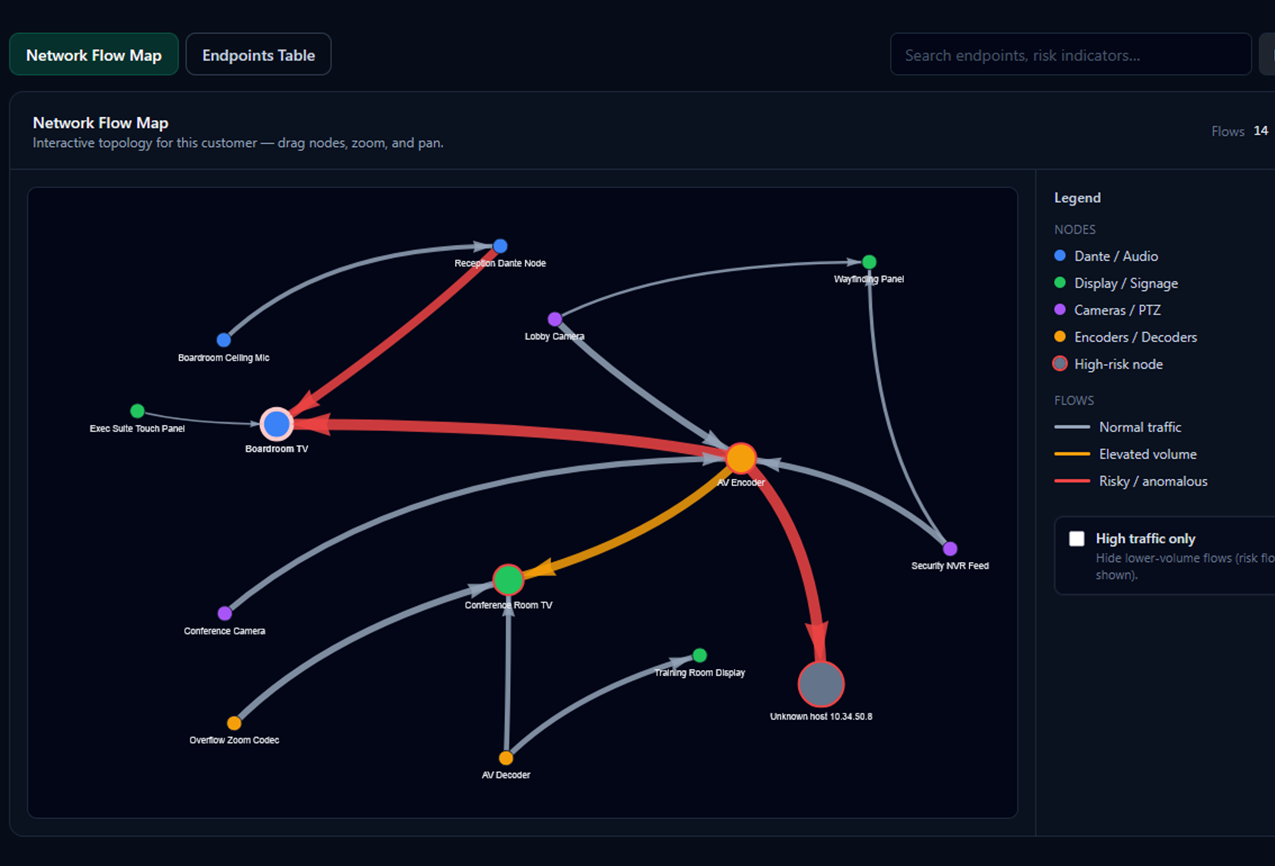
AVoIP Guard ingests standard NetFlow, IPFIX, and sFlow from the gear you already have—then applies AV-specific baselines and AI detection so you see risk before it becomes an incident.
Dashboard preview
Open interactive demo →Point NetFlow, IPFIX, or sFlow at your collector port and watch baselines build.
Endpoint security tools were built for laptops and servers. Not for multicast-heavy, protocol-rich AV estates where a "device" might be a Dante node, an NDI bridge, or a Crestron NVX encoder with no agent slot.
Generic flow tools see IPs and ports—not whether traffic is legitimate Dante discovery vs. anomalous multicast fan-out.
Encoders and signage players can't run EDR. Pushing agents creates support risk and still misses network-level behavior.
IT-centric alerts don't explain AV impact. Technicians ignore them—or escalate everything to your senior engineers.
Per-client silos hide which customer is trending high-risk across dozens of conference rooms and retail sites.
AVoIP Guard closes the gap with flow metadata only—the same NetFlow, IPFIX, or sFlow export your Netgear, Meraki, Fortinet, UniFi, or other network gear already supports.
Four processing layers transform raw flow metadata into AV-specific risk signals—without touching a single media stream.
Data sources
Zero agents · No span ports
Receives NetFlow, IPFIX, and sFlow over UDP. Each tenant environment gets a dedicated collector port—clean multi-tenant isolation from day one.
Traffic fingerprinted by AV protocol—Dante, NDI, ST 2110, RTSP, Crestron CIP, Extron, Q-SYS, and AMX control channels identified from flow metadata alone.
Per-environment behavioral baselines built continuously over time—including VLAN membership and traffic cadence. Daily-refreshed threat intel (Spamhaus DROP/EDROP, abuse.ch, Tor exits) cross-referenced against every flow.
Findings weighted by AV context, learning-period status, and severity—then correlated across stages into a compromise narrative when a kill chain emerges. High-confidence signals surface on the MSP risk leaderboard with plain English guidance and runbook links.
Risk signals out
High-confidence threats that matter to MSPs managing professional AV environments—not generic network noise.
We don’t just fire single alerts—we chain ordered stages into a compromise narrative. When a new endpoint, scan, and egress line up in sequence, you get one high-confidence story instead of three disconnected tickets.
Any AV subnet device communicating with IPs from daily-refreshed threat feeds—Spamhaus DROP/EDROP, abuse.ch Feodo/SSLBL, Tor exit nodes.
AV devices reaching public internet destinations—strong indicator of C2 callbacks, unauthorized firmware pulls, or data exfiltration from the AV VLAN.
Unknown hosts attempting Crestron CIP, Extron, Q-SYS, Dante control, or AMX protocols—a precursor to room takeover or configuration tampering.
Periodic low-volume conversations to external destinations—the classic C2 heartbeat pattern—while excluding known-good AV timing and discovery traffic.
An encoder or control processor suddenly reaching many new peers in a short window—often scanning, worm propagation, or rogue matrix routing.
Post-compromise reconnaissance from the AV subnet—including stealth SYN-only probes. AV-tuned thresholds prevent false positives from legitimate wide fan-out by encoders.
Large deviations from established behavioral baselines—extreme bursts indicating compromise or misconfiguration, tuned to ignore normal show-traffic spikes.
An AV endpoint appearing on a VLAN outside its learned set—policy drift, mispatch, or lateral movement that flat IP lists miss.
All signals are scored with AV-specific context and learning-period awareness so legitimate show traffic, multicast discovery, and normal AV behavior stay quiet.
Three architectural choices that make these detections possible—without touching a single AV endpoint.
Standard NetFlow, IPFIX, and sFlow from gear you already operate—Netgear, Meraki, FortiGate, UniFi. No firmware changes, no stream latency, no support risk on AV endpoints.
Detection and baselines account for Dante, NDI, ST 2110, multicast patterns, and AV control protocols—not just "port 5353." Per-environment behavioral models with AI-assisted triage.
Multi-tenant risk leaderboard, self-serve environment setup, plain English alerts with runbooks, and white-labeled 30-day security reports. One dashboard for every customer.
Five steps from existing network exports to actionable AV security insight
Configure your firewall, core switch, or gateway/router to send NetFlow, IPFIX, or sFlow to AVoIP Guard. No agents on AV hardware.
Self-serve customer creation in the dashboard. Each tenant gets a dedicated UDP collector port for clean isolation.
We classify Dante, NDI, ST 2110, RTSP, and professional AV patterns—then build behavioral baselines per environment.
Anomalies—rogue talkers, unusual peers, off-hours volume—are scored with context so legitimate show traffic isn't drowned out.
Plain English alerts with recommended actions and linked runbooks—on your MSP risk leaderboard and per-customer maps.
Walk through the Security Command Center, risk leaderboard, interactive flow map, and alert detail—the same experience your team will use with real customer data.
Open live demoTry the live demo, then start your free beta when you're ready. No agents. No stream impact. Just clarity.