Somewhere in your building, a device switches HDMI signals, encodes video streams, or routes audio between a boardroom and a DSP. It has run the same firmware since installation. No one in IT has ever logged in. It might even be reachable from the internet after a remote support session two years ago that was never closed.
This is AV over IP infrastructure. It has become one of the most overlooked corners of enterprise networks: full Linux systems on IP networks, complete with live microphones and cameras, often bridging directly to the rest of your infrastructure. Yet few organizations treat these devices like the computers they truly are.
Why AVoIP Endpoints Remain Exposed
Several structural issues keep this category vulnerable:
- Ownership gap: Integrators often specify, install, and maintain AV systems. They frequently operate on isolated switches or VLANs outside corporate security inventories and monitoring.
- Large attack surface from a small vendor base: Many AVoIP platforms run embedded Linux with web management, CGI APIs, and telnet/SSH services. They match server complexity but lack equivalent patching discipline.
- Shared codebases: Hardware is often white-labeled or OEM'd. One vulnerability can affect multiple "different" products.
- Remote management exposure: Bridging devices to the internet for support or centralized control makes them visible in Shodan scans, complete with model and firmware details in HTTP headers.
- Patch friction: Firmware updates are often manual, poorly documented, or restricted to dealer portals. This leaves fleets running outdated code for years.
Common AVoIP Threat Vectors
1. Exposed management interfaces
Web UIs, telnet, SNMP, and vendor cloud bridges often face the internet unintentionally. Attackers use simple Shodan or Censys queries with known AV device fingerprints to find open portals.
2. Unauthenticated command execution
CGI endpoints or API parameters that pass unsanitized input to a shell (with no auth) allow a single request to deliver a root shell. Recent CVEs demonstrate this remains a live risk.
3. Default and hardcoded credentials
Admin/admin defaults or vendor debug accounts still appear in advisories.
4. Network pivot point
Compromised devices initiate unexpected outbound connections: SMB probes, RDP/SSH attempts, or internal port scans across unauthorized subnets. These go unnoticed without SIEM rules for AV endpoints.
5. Stream interception and eavesdropping
Unencrypted multicast video/audio streams are easy to capture on the same segment. This passive threat is among the hardest to detect.
6. Silent surveillance
Some vulnerabilities let attackers activate recording on devices with live mics and cameras, without any visible indication in the room.
7. Disruption and denial of service
Crafted packets can crash processors, or unauthenticated factory-reset endpoints can wipe configurations instantly.
Real-World Case Studies
QSC Q-SYS Core processors (CVE-2026-41528 / CVE-2026-41529, disclosed 2026)
A researcher extracted an unencrypted embedded Linux firmware image and discovered undocumented, unauthenticated web CGI endpoints. One telemetry endpoint wrote a URL parameter unsanitized into a shell environment file sourced by a root init process. This provided a direct path from one HTTP request to root shell (CVSS 9.9).
The same interface enabled factory resets, SSH/Telnet enablement, topology dumps, and packet captures—all without login. These processors power boardrooms, lecture halls, courtrooms, and more, often bridging AV and corporate networks. The vulnerability persisted through one firmware release after initial disclosure, highlighting slow patch cycles in this space.
Crestron HD-MD4X2-4K-E (CVE-2022-23178)
CVSS 10.0: Loading the unauthenticated admin web interface returned credentials in JSON. No advanced exploit needed.
Crestron Automate VX (CVE-2025-47418)
A network API call could silently enable audio/video recording with no on-screen warning.
What a Real AVoIP Attack Chain Looks Like
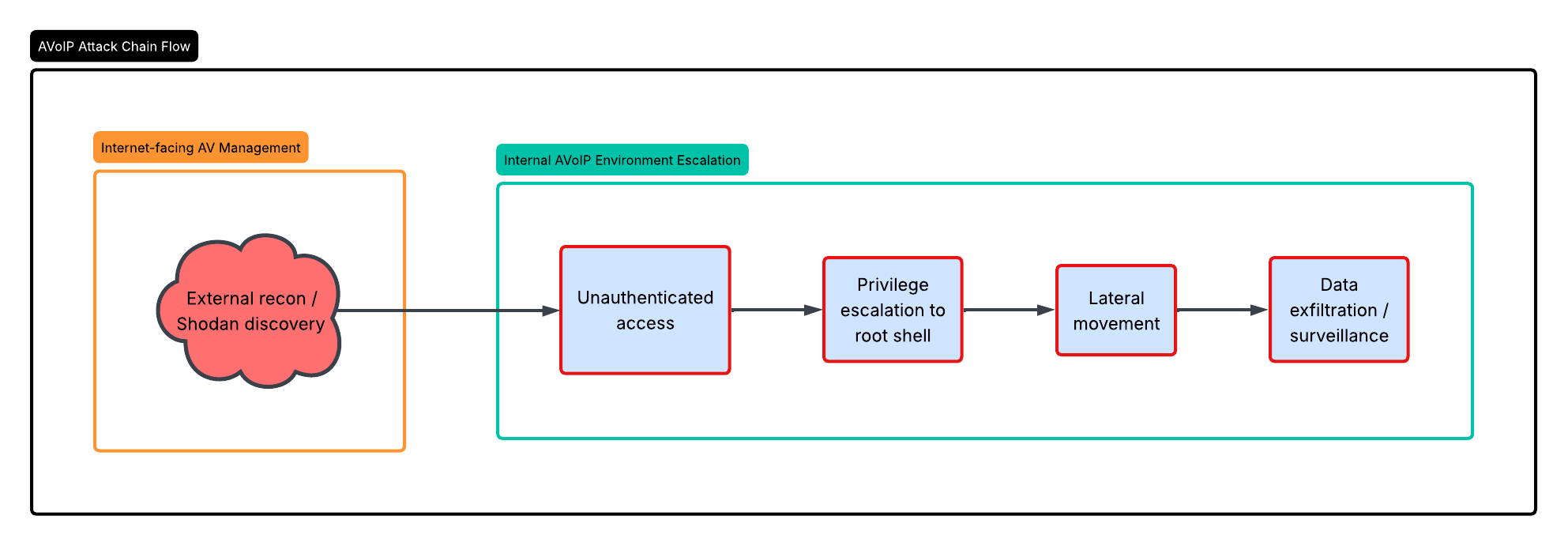
- Identify internet-facing AV management interfaces via Shodan fingerprinting (headers often leak vendor, model, and firmware).
- Gain unauthenticated access to admin UI or CGI endpoint.
- Achieve command execution and root shell.
- Install persistent backdoor (e.g., enable SSH, change root password).
- Perform lateral movement and scanning across VLANs.
- Collect data via stream interception, recording activation, or further compromise.
How to Protect Your AVoIP Network
Treat AV endpoints with the same rigor as other networked devices. Key mitigations include:
- Full asset inventory: Track every AVoIP device in your central system alongside servers and endpoints.
- Network segmentation: Isolate AV networks from corporate/production environments. Avoid flat topologies connecting boardroom switches to domain controllers.
- Behavioral monitoring: Baseline normal traffic from these devices. Alert on anomalies like sudden port scanning. Dedicated AVoIP monitoring tools can automate risk scoring, flow analysis, and alerts for MSPs and enterprises.
- Contractual patching: Make firmware update cadence a requirement with integrators and vendors.
- Strong access controls: Enable authentication everywhere, even if optional. Many vulnerabilities worsen when defaults leave controls disabled.
- Stream encryption: Use supported protocols to protect multicast video and audio.
- Ongoing vigilance: Regular scans, principle of least privilege, and solutions that provide agentless visibility into AV flows.
Tools designed specifically for AVoIP environments—like AVoIP Guard—help close this gap by collecting and analyzing NetFlow/sFlow data, enriching device info, and delivering AI-driven risk alerts without disrupting existing setups.
Closing: Time to Close the Blind Spot
These threats are not exotic zero-days. They reuse classic issues (unauthenticated interfaces, default credentials, command injection) that IT solved for servers decades ago. AV hardware simply never faced the same scrutiny.
The solution is straightforward: Apply mature security practices to this critical but overlooked category. Organizations that inventory, segment, monitor, and patch AVoIP endpoints will reduce risk dramatically. Those that do not risk turning boardroom gear into an entry point for broader compromise.
What does your AVoIP security posture look like today? Auditing endpoints and flows is a strong first step.
FAQ
Why are AVoIP endpoints such a big security risk in 2026?
AVoIP devices are essentially full Linux computers with cameras and microphones, but they rarely receive the same security scrutiny as traditional IT assets. Combined with slow patching and weak default configurations, they have become an attractive target for attackers.
What are the most critical AVoIP vulnerabilities right now?
Recent examples include unauthenticated remote code execution in QSC Q-SYS (CVE-2026-41528/29) and credential disclosure in Crestron devices. Many involve exposed management interfaces and poor input sanitization.
How can MSPs protect client AV networks?
Focus on asset inventory, network segmentation, behavioral monitoring, and automated firmware tracking. Specialized tools like AVoIP Guard that provide flow-level visibility and risk scoring make this significantly easier at scale.
Should AV networks be completely isolated from corporate networks?
Full isolation is ideal where possible, but at minimum they should be segmented with strict access controls. Any bridging to corporate resources should be tightly monitored.
How often should AVoIP firmware be updated?
Treat it as a contractual requirement. Aim for quarterly reviews at minimum, with critical patches applied as soon as they are available.
Sources
- Crestron Security Advisory (CVE-2022-23178)
- CVE Record for CVE-2025-47418
- QSC Q-SYS Advisory (CVE-2026-41528 / CVE-2026-41529)
- Tenable Research on presentation system vulnerabilities
AVoIP Guard provides automated monitoring and risk intelligence for these exact challenges. Learn more at avoipguard.com.